
The problem with buying for a gamer girl is rarely generosity — it is information. A gift card feels safe precisely because it asks nothing: no platform to get right, no size to guess, no game edition to confuse, no region or account to mismatch. But that safety is also why it can land as impersonal, and why it so often sits unused while the thing she actually wanted stays unbought. Guess the other way, without the information, and the failures are just as predictable: a game for a console she does not own, a headset that hurts after an hour, a hoodie in a size chosen by optimism, a download code for the wrong storefront, or a piece of fan merch that looks nothing like its listing photo. None of those failures is about taste. All of them are about a small set of knowable facts — what she plays on, what she already owns, what fits her body and her space, what a product’s rating and return terms actually say — and every one of them can be learned without ruining the surprise. This guide works through that method in order: the four questions that replace guesswork, then the specific checks for games, apparel, headsets, desk and eye-comfort gifts, fan merch, and gifts for younger gamers, and finally the ordering, shipping, and return rules that protect you when a gift still misses — including the honest cases where a gift card, bought carefully, is the right answer after all.
Start here: Browse the gamer girl apparel collection on this site for the wearable end of this guide, then use the size, fit, and return checks below before anything goes in a cart.
Key Takeaways
- A gift card feels safe because it needs no information; a real gift succeeds for the opposite reason — a few specific facts learned in advance.
- Four questions do most of the work: what platform she plays on, what she already owns, what sizes and fits she actually wears, and what her space can hold.
- Games carry the most hidden traps: platform, edition, region, and age rating all have to match before a game is a gift instead of a chore.
- Headsets, lighting, and eye-comfort gifts are health-adjacent purchases — safe-listening and eye-strain guidance from health authorities is part of choosing them well.
- Fan merch splits into licensed and unlicensed, and copyright and trademark basics explain why the licensed version is usually the safer gift.
- A gift card is not always wrong — it is right when she is saving toward something specific — but it should be bought from a trusted seller, kept with its receipt, and never confused with a payment method for anyone demanding one.
Table of Contents
- The Four Questions That Replace a Gift Card
- Games Themselves: Platform, Edition, and Rating Checks
- Apparel and Wearables: Size Is a Question, Not a Guess
- Headsets and Audio Gifts: Comfort and Safe Listening
- Desk, Lighting, and Eye-Comfort Gifts
- Fan Merch, Art, and the Licensed-vs-Unlicensed Line
- Younger Gamers, Accounts, and Privacy: The Extra Checks
- Ordering, Shipping, Returns — and When a Gift Card Is Actually Right
- Our View
- FAQ
- Sources
- Recommended
The Four Questions That Replace a Gift Card
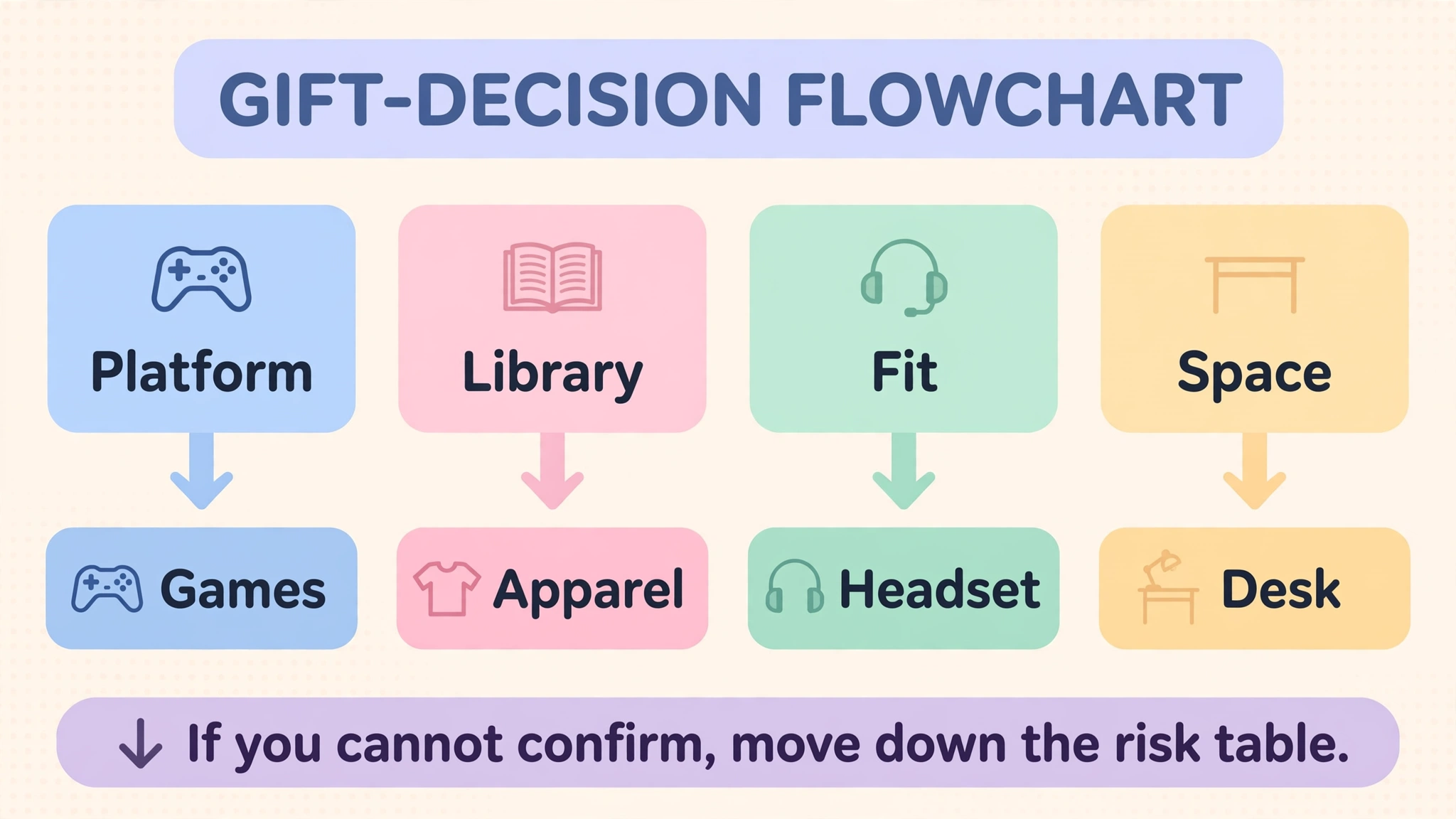
Every good gamer gift starts as four answers, not as a product — platform, library, fit, and space — and collecting them is easier and less revealing than most gift-givers fear. Platform means the exact machines she plays on, including which generation and whether her games are physical or downloads, because that single fact decides whole categories in or out. Library means what she already owns and is currently playing, which prevents the most deflating gift of all: a duplicate of a favorite she bought herself months ago. Fit means real sizes and preferences — clothing sizes in brands she actually wears, whether she wears glasses under a headset — rather than a guess averaged from a size chart. Space means where she plays: desk width, room for a larger accessory, a dorm corner versus a house — a gift that ignores space can be perfect and still unusable.
Collecting these answers does not require an interrogation that spoils anything. Notice what is on her desk and screen, ask what she is playing lately and listen for the machine as much as the title, ask a mutual friend who already knows, or ask her directly for a wishlist — a list with several items preserves the surprise of which one arrives. The Federal Trade Commission’s consumer advice to know before you buy online makes the shopping-side version of the same point: pay attention to the details before the purchase, including when an item ships and what to do if you need to return it. Details first, cart second.
The table below turns the four questions into a risk map, ordered from the most information-hungry gift type to the least. If you cannot answer for a high-risk category, move down the table rather than guessing harder.
| Gift type | What you must know first | Risk of getting it wrong |
|---|---|---|
| A specific game | Exact platform and generation, physical or download, whether she owns it, age-rating fit | High — unplayable or duplicate |
| Download code or in-game currency | Exact storefront and account region | High — code may not redeem |
| Apparel | Her real size in comparable brands, fit and color preferences | Medium-high — unworn if fit is off |
| Headset | Glasses use, head/ear comfort, wired or wireless preference, platform compatibility | Medium-high — discomfort is personal |
| Desk and lighting gifts | Desk dimensions, existing setup, eye-comfort needs | Medium — may not fit the space |
| Fan merch and art | The exact game or character she loves, licensed versus unlicensed | Medium — wrong character misses entirely |
| Accessories and small extras | What she already owns and uses daily | Low-medium — duplicates are the main risk |
| A gift card (done deliberately) | The exact storefront or store she actually uses | Low if the store is right; high if it is not |

Games Themselves: Platform, Edition, and Rating Checks
A game is the most personal gift on the table and the easiest to make unplayable, because a game is not one product — it is a platform, an edition, a format, and a rating, and all four have to match her life. Platform first, and precisely: a game bought for the wrong console family is a return errand, and even within one family, generations matter, as does the divide between a physical disc or cartridge and a download code. A download code adds two more traps — it belongs to a specific storefront, and storefront accounts are regional, so a code bought for one region may not redeem on an account registered in another. If you cannot confirm storefront and region, a physical copy or a different category is the honest move. Edition is the quieter trap: buying the base version for someone saving toward the expanded one — or an expansion for a base game she does not own — turns generosity into homework for the recipient.
Rating is the check that matters most when the gamer is younger, and it has a proper tool behind it. The Entertainment Software Rating Board’s guidance on selecting appropriate video games explains that its ratings have three parts worth reading together: the age category, the content descriptors that say what actually prompted the rating, and the interactive-elements notices that flag things like in-game purchases and user interaction. The age letter alone is a blunt instrument — two games can share a category for entirely different reasons, and the descriptors are where you learn which reasons they are. Look the title up before you buy it, and if the recipient is a child in someone else’s household, treat the rating as a conversation to have with her parents, not a decision to make alone in a store aisle.
Two softer checks finish the section. Ownership: confirm she does not already have the game, because a duplicate of a beloved game is still a duplicate. And timing: a game she finished on a borrowed copy was the right gift six months ago, not now. The best evidence is recent — what she is playing, and what she has deliberately not bought for herself yet. That last category, the wanted-but-not-bought, is the sweet spot this guide is hunting.
Apparel and Wearables: Size Is a Question, Not a Guess
Apparel is the most giftable category in this guide and the one most often ruined by a single guessed number, because clothing sizes are not a standard — they are a per-brand opinion. The same person wears different labeled sizes in different brands, cuts differ between relaxed and fitted versions of the same garment, and gaming apparel adds its own variables: oversized fits are supposed to drape, fitted tees are not, and a hoodie bought for layering wants different room than one worn alone. So answer the size question from her actual wardrobe, not a generic chart: the size she wears in a comparable brand, in a comparable cut. Routes to that answer are the low-drama ones from the first section — a peek at a label in something she wears constantly, or a question to someone who has bought for her before. Estimating from appearance does not work; it is both unreliable and, when the gift is opened, visibly a guess.
Beyond size, apparel rewards attention to how she actually dresses when she plays and streams. Some gamers live in oversized hoodies; some prefer fitted pieces; some keep the gaming reference to a small graphic rather than a large print. If her taste runs toward streetwear, the soft palettes and oversized proportions of Korean street style are a useful direction for a gift that reads as fashion first and fandom second. Color is the other under-asked question: a gift in the palette she wears weekly gets worn, while a gift in yours gets thanked.
The practical protections are simple. Buy from a seller whose return and exchange terms you have actually read, keep the tags and receipt until the gift has been tried on, and prefer the seller whose size information is specific — garment measurements rather than a bare letter. You are not trying to achieve certainty; you are making the remaining uncertainty cheap to fix. A hoodie she exchanges for the next size up is a successful gift; a guessed size from a no-returns seller is a gamble wearing a ribbon.
Headsets and Audio Gifts: Comfort and Safe Listening
A headset is worn against the body for hours at a time, which makes it a comfort purchase and a hearing-health purchase before it is a technology purchase — and both facts should shape how you choose one. Comfort first, because discomfort is disqualifying and deeply personal: clamping pressure one person never notices gives another a headache, and a headset that must coexist with glasses is a different product from one that does not. If she wears glasses, that alone should filter your shortlist, and her current headset’s style — over-ear or in-ear, wired or wireless — is evidence about what her ears tolerate. Compatibility is the second filter: confirm it works with her platform and the devices she actually uses. A gift that works on only one of her devices will spend its life in a drawer next to the one that works on all of them.
Safe listening is the part of headset gifting almost nobody thinks about, and the health authorities are aligned on it. The World Health Organization’s making listening safe initiative exists because recreational listening at high levels puts a generation at risk of preventable hearing damage, and its work includes standards for safe listening features in devices — which makes volume limiting a genuine gift criterion, not marketing garnish. The National Institute on Deafness and Other Communication Disorders’ page on noise-induced hearing loss explains the mechanism plainly: sounds at or below a moderate level are unlikely to harm hearing even over long exposure, while long or repeated exposure above a higher threshold can cause loss, and the louder the sound, the less time it takes. A headset that seals well helps unintuitively — when outside sound is blocked, the wearer need not turn the volume up to compete with the room.
For younger gamers the same point arrives with a child’s name on it. The Centers for Disease Control and Prevention’s teen-focused material on noise-induced hearing loss notes that prevention is the effective strategy because this damage is irreversible, and its headphone tips double as gift criteria: choose headphones that block surrounding sound so volume stays lower, and take regular breaks. Between two headsets, the one with volume limiting and a good seal is the better gift.
Desk, Lighting, and Eye-Comfort Gifts
Desk gifts succeed or fail on measurements and habits rather than taste, which makes them the most researchable category here — and the one where a tape measure beats a hunch every time. Start with the physical audit: how wide and deep is her desk, what already occupies it, and whether there is room for the thing you are imagining at all. A larger accessory for a small desk is not a gift, it is a storage problem, and dorm and bedroom-corner setups punish size optimism hardest. Then audit the gaps: what does her setup lack that she works around? A lamp improvised from a phone flashlight, a monitor at book-stack height, cables managed by hope — these workarounds are a gift list she has already written for you, in behavior rather than words. The best desk gifts are boringly specific: the exact missing piece, sized to the exact space.
Lighting and eye comfort deserve their own care because long sessions make eyes the limiting factor. The American Optometric Association’s overview of computer vision syndrome describes digital eyestrain as a group of eye and vision problems that build with prolonged screen use, influenced by lighting, glare, viewing distance, and posture — which is why a well-chosen lamp or a stand that puts the screen at a sane height can be a more loving gift than another decorative object. The American Academy of Ophthalmology’s guidance on computers and eye strain adds the behavioral half: people blink far less often at screens, which dries the eyes, and regular breaks to look into the distance rest the focusing effort.
One caution keeps this category honest: resist novelty lighting that serves a photograph better than a player. Light that reduces glare, does not reflect in her screen, and can be dimmed for late sessions is useful, and usefulness is what survives the first month. Ask of every desk object whether it will be touched daily in January, not whether it photographs well in December.

Fan Merch, Art, and the Licensed-vs-Unlicensed Line
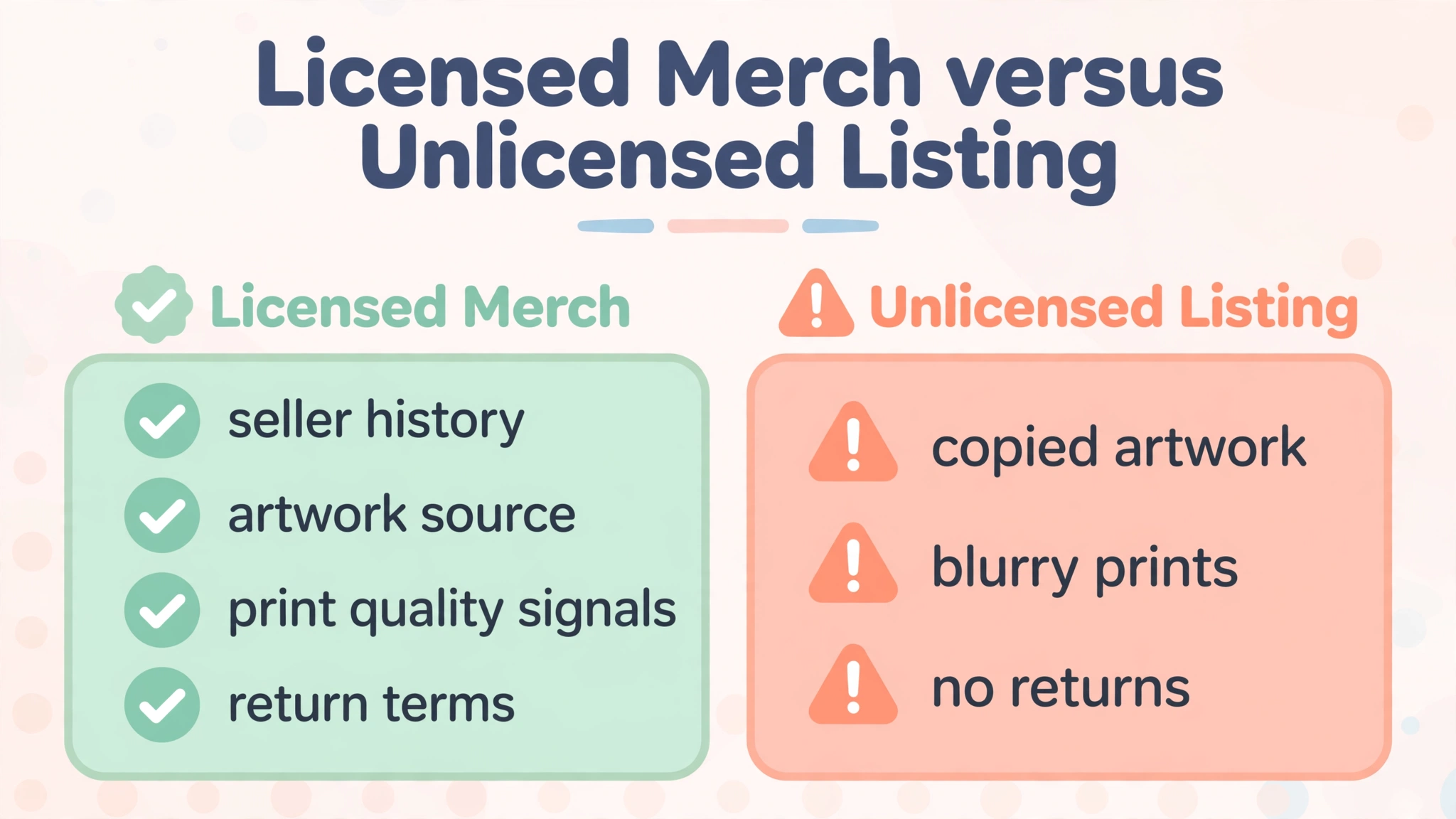
Fan merch is where a gift gets its emotional power — the exact character, the exact game, the exact joke only a fellow fan catches — and also where quality and legality vary the most, so this category rewards a buyer’s two-minute education. The first distinction is licensed versus unlicensed. Licensed merch is made with the rights holder’s permission, which in practice correlates with everything a gift-giver wants: consistent artwork, accurate colors, print quality that survives washing, and a seller who will still exist if something needs exchanging. Unlicensed merch runs from talented independent artists making original fan art to listings that have simply lifted official artwork onto a shirt. The gift risk concentrates at that second end: lifted-art listings are where the blurry print and the design that fades in three washes live, because no one with a reputation at stake ever approved the file.
The legal basics underneath explain the market you are shopping in. The U.S. Copyright Office’s frequently asked questions set out the fundamentals: copyright protects original creative works, and using protected work generally runs through the rights holder’s permission — game artwork and character designs sit inside that protection. Trademark adds a second layer: the U.S. Patent and Trademark Office’s trademark basics explain that names and logos used to identify a brand are trademarks, which is why a game’s title on a shirt is a separate question from the art beside it. Buying a fan-made piece is not a legal problem for the buyer in the ordinary case — enforcement aims at sellers — but sellers who license or sell clearly original fan-inspired art are far more likely to deliver a gift that looks like its photo.
The taste checks matter as much as the legal ones. Fan identity is specific: the favorite character is rarely the franchise’s most famous one, and the beloved game may be the older entry rather than the current release. Merch with the wrong character is not a near-miss — it announces that the giver knows she likes the series but not her. So this is where the mutual-friend and wishlist routes earn their keep most, and where a small, exactly-right item beats a large, approximately-right one. When in doubt, go smaller and more specific.
Younger Gamers, Accounts, and Privacy: The Extra Checks
Gifts for younger gamers carry a second recipient — the household’s rules — and a gift that ignores them creates work for parents instead of joy for the player. The rating check from the games section is the entry point, but modern games are accounts as much as objects: many involve online interaction, in-game purchases, and personal information collected at sign-up. A gift that requires a new account or subscription is partly a privacy decision, and for a child that decision belongs to her parents — so give it with the parents in the loop before purchase, not explained to them after unwrapping. Ask what platforms and services are already approved in that house, and buy inside the approved list.
The legal frame behind those household rules is worth knowing. The Federal Trade Commission’s guidance on protecting your child’s privacy online explains that the Children’s Online Privacy Protection Act gives parents control over personal information companies collect from children under 13 — covered services must get parental consent before collecting it and must honor parents’ choices about how it is used. That is why sign-up flows for younger players keep routing through a parent, and why a well-meant gift of a new game service can stall at a consent screen the giver never anticipated. For a gamer under 13, prefer gifts that work inside accounts her parents have already set up, and treat anything requiring fresh personal information or a new profile as a parents-first conversation, full stop.
The same care applies to money-shaped gifts for the young. In-game currency and download codes can be the perfect small gift — when platform, storefront, and region all match the account her parents manage, and when the household is comfortable with in-game spending. Some are not, and their reasons are their own. Physical gifts and accessories carry none of these complications, which is why gift-givers to other people’s children default to the tangible and let the parents handle the digital.
Ordering, Shipping, Returns — and When a Gift Card Is Actually Right
The last section is the safety net: how you buy matters almost as much as what you buy, because a gift’s success is only settled when it has arrived, fitted, worked, and been kept. Buy with the return already in mind. Before paying, read the seller’s delivery, return, and refund terms for this item — opened electronics, print-on-demand apparel, and digital codes each carry different return realities, and a digital code should be treated as final unless the seller says otherwise in writing. Timing has a federal floor for online orders: the Federal Trade Commission’s business guide to the Mail, Internet, or Telephone Order Merchandise Rule explains that a seller must have a reasonable basis for its stated shipping time, and if no time is stated, must reasonably expect to ship within 30 days — and if it cannot ship on time, it must seek the buyer’s consent to the delay or refund the unshipped merchandise. So order early enough that a delay is an inconvenience, not a missed occasion, and keep the receipt until the gift has been kept.
And now the honest part: a gift card is not always wrong. It is right when she is saving toward a specific larger item and your card is a genuine contribution to it, when she has named the exact storefront herself, or when she genuinely prefers choosing — honoring that is respect, not laziness. Done deliberately, for the store she actually uses, with a note naming what you hope it becomes, it is a thoughtful gift. Done by default, for a store she rarely touches, it is the thing this guide exists to replace.
What a gift card must never be is a payment method for someone else’s demand. The Federal Trade Commission’s guidance on avoiding and reporting gift card scams is blunt: only scammers tell you to buy a gift card and hand over the numbers on the back; no real business or government agency will ever ask to be paid that way. The same page gives the safe way to buy one as a genuine gift — stick to stores you know and trust, inspect the card for tampering, and always keep a copy of the card and the store receipt, which let you report a problem and ask for your money back. Teach that to anyone you give a card to, especially a younger gamer receiving her first one: the numbers on the back are the money, a photo of them is the money, and anyone who asks for them urgently is not a prize, a company, or an official — whatever the story says.
Our View
A gift card says “I remembered, and I did not want to risk being wrong.” A real gift, chosen with four answers and a handful of checks, says something better: “I know what you play on, what you wear, what your desk looks like, and what you have been wanting.” The risk difference between the two is much smaller than it feels — a platform confirmed, a size learned, a rating read, a return policy checked — and the warmth difference is the whole point of giving anything at all. Ask the questions, buy the specific thing, keep the receipt, and let the gift card return to its proper job: the deliberate contribution, for the right store, when it is genuinely what she wants.
— The GamerChicksRule Team
FAQ
How do I find out her size or platform without ruining the surprise?
Use the low-drama routes: observe what is on her desk and screen, read a label on clothing she wears constantly, ask a mutual friend or family member who already knows, or ask for a wishlist with several items on it — the surprise of which item arrives survives intact. What matters is learning the fact, not preserving total secrecy.
Is a gift card ever the right choice?
Yes — when she is saving toward a specific larger item, when she has named the exact store or storefront herself, or when she genuinely prefers to choose. Buy it from a store you know and trust, inspect it for tampering, keep the card copy and receipt, and add a note naming what you hope it becomes. A deliberate card for her actual store is a good gift; a default card for a store she rarely uses is not.
What if I buy a game and it is the wrong platform or she already owns it?
This is why the return check comes before the purchase: buy from a seller whose return terms you have read, keep the game sealed and the receipt kept, and confirm platform and ownership in advance whenever you can. A sealed game with a receipt is a five-minute exchange; an opened download code for the wrong storefront usually cannot be fixed at all.
How do I check whether a game is appropriate for a younger gamer?
Look the title up in the ESRB’s system and read all three parts of the rating — the age category, the content descriptors that explain it, and the interactive-elements notices covering things like in-game purchases and user interaction. Then check the household’s own rules: for a child under 13, accounts and services involve parental consent for personal information, so gifts that need new accounts belong in a conversation with her parents first.
What is the gift-card scam I should warn her about?
Anyone who contacts her — by phone, text, email, or social media — and tells her to buy a gift card and share the numbers or a photo of the back is a scammer, whatever the story: a prize, a bill, a tech problem, an official. No real business or agency takes payment that way. If it happens, the card and receipt go to the gift card company to report it and ask for a refund, and the scam gets reported to the FTC.
Sources
- FTC on what to know before you buy something online
- FTC business guide to the Mail, Internet, or Telephone Order Merchandise Rule
- FTC on avoiding and reporting gift card scams
- FTC on protecting your child’s privacy online (COPPA)
- ESRB on selecting appropriate video games
- WHO on making listening safe
- NIDCD on noise-induced hearing loss
- CDC teen newsletter on noise-induced hearing loss
- American Optometric Association on computer vision syndrome
- American Academy of Ophthalmology on computers, digital devices, and eye strain
- U.S. Copyright Office frequently asked questions
- USPTO trademark basics