

The problem with anime peeker stickers is that they look like the simplest purchase in the world — a character, a window, done — right up until one of three things goes wrong. The sticker covers a part of the glass you are not allowed to cover, and what was a decoration becomes an equipment violation. Or it goes on beautifully and is peeling at the corners inside a season, because nobody told you the difference between the vinyl types or that the glass was not actually clean. Or it goes on legally and lasts for years, positioned exactly where it blocks the one sightline you needed at an intersection. None of these failures is about the artwork. All of them are about placement, material, and rules — and all three are knowable before a single backing sheet is peeled. This guide works through them in order: what a peeker sticker actually is and how it differs from other car decals, where on the car the law and plain visibility leave room for it, how to check your own state’s rules in minutes, which vinyl survives outdoors, and the application method the film manufacturers themselves describe. By the end, the only decision left should be the fun one — which character.
Start here: See the anime peeker stickers for cars available on this site, then use the placement and rules checks below before yours goes anywhere near glass.
Key Takeaways
- A peeker sticker is designed to appear over an edge — most often a window edge — so placement is part of the design, not an afterthought.
- The legal line in most states is the driver’s view: material that obstructs or reduces the view through the windshield or front side windows is restricted or prohibited, while rear glass usually has far more room — with conditions.
- Rules vary sharply by state and are written around window tint and obstructions generally, not around stickers specifically — you check the obstruction rule, not a sticker rule.
- Cast vinyl outlasts calendered vinyl outdoors; the manufacturer’s own application guidance — clean surface, the right temperature range, dry method for small decals — is what decides whether it stays.
- Visibility is a safety question before it is a legal one: if a placement makes you move your head to see around your own decoration, it is in the wrong place.
- Fan art carries real copyright and trademark limits for sellers; buying from sellers who respect them is the buyer’s simplest protection.
Table of Contents
- What a Peeker Sticker Actually Is
- Where They Go: The Placement Map
- The Rules: Obstruction Law, Tint Law, and Your State
- Visibility: The Safety Test Behind the Legal One
- Vinyl Types and Why One Peels by Spring
- Application, the Manufacturer’s Way
- Fan Art, Copyright, and Buying Responsibly
- Our View
- FAQ
- Sources
- Recommended
What a Peeker Sticker Actually Is
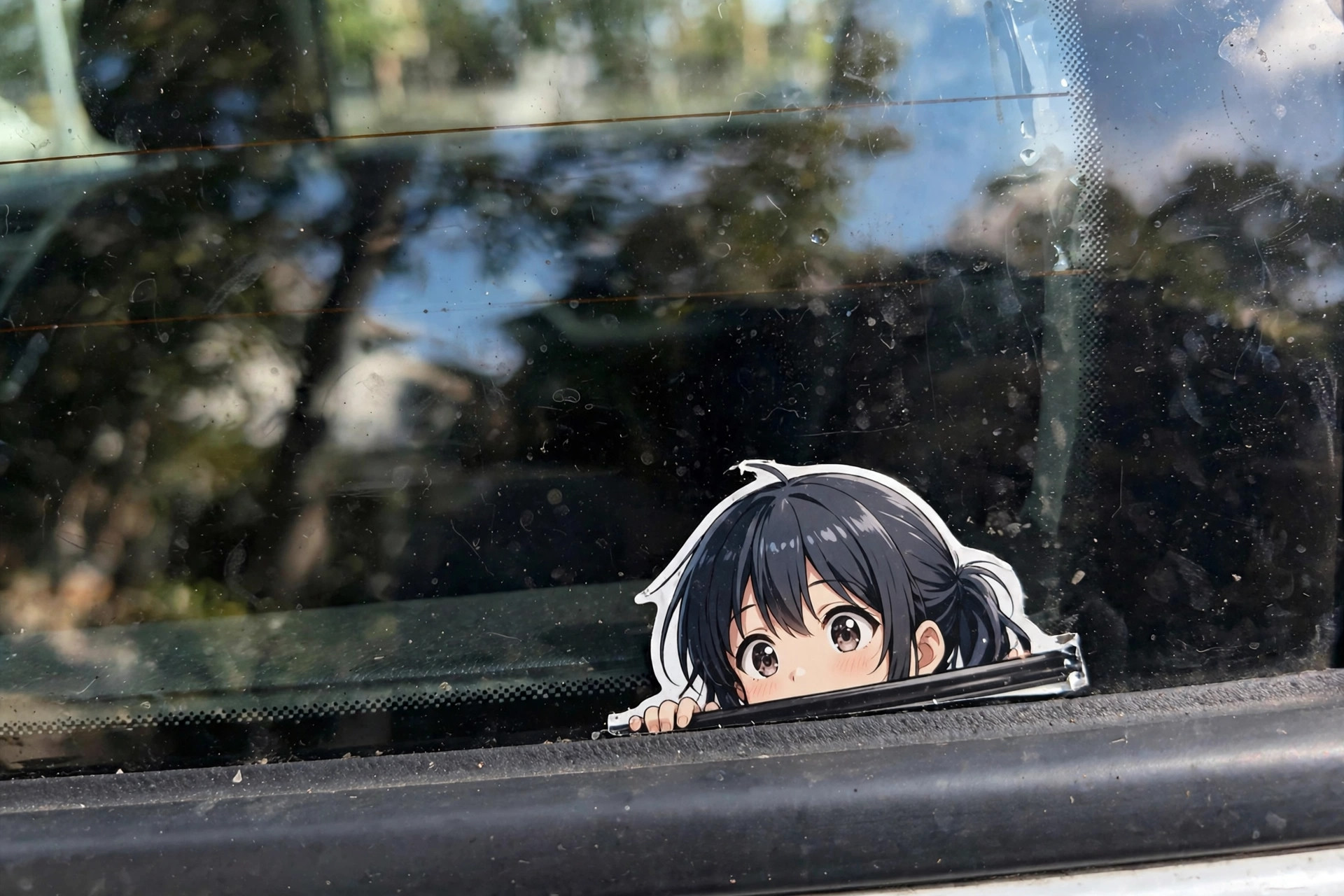
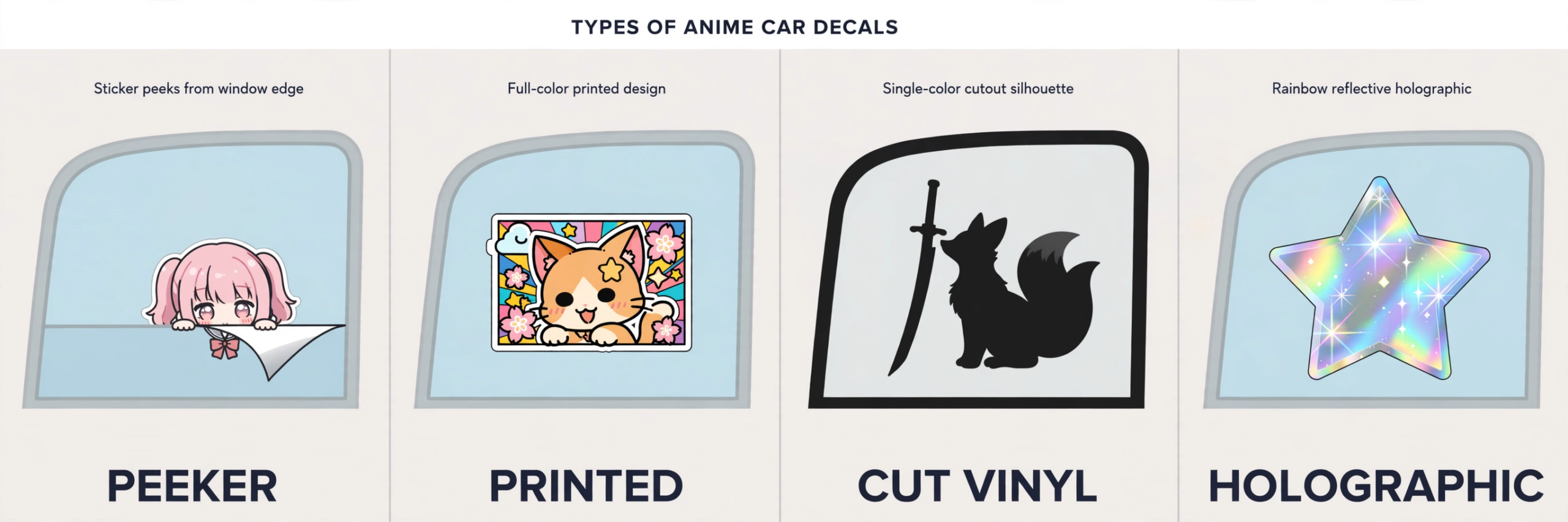
A peeker is a die-cut vinyl decal drawn so that the character appears to be peeking over an edge — and that edge is doing half the artwork’s job. The character is typically shown from the eyes or the nose up, sometimes with hands gripping the edge, and the design is completed by whatever it is stuck to: the bottom edge of a rear window, the top of a bumper line, the rim of a laptop lid, the edge of a phone case. That is what separates a peeker from the other decals it gets shelved with. A full-body sticker carries its whole design inside its own outline and can go anywhere flat. A window banner is lettering meant to be read. A peeker is an interaction between the art and the object, which is why the same sticker can look perfect on one edge and meaningless floating in the middle of a panel. When you shop, you are really shopping for an edge first and a character second.
The construction is standard for quality outdoor decals even when the art is not: a printed or cut design on adhesive vinyl, usually supplied on a backing sheet with a transfer layer on top that holds the pieces in alignment while you apply it. That transfer layer matters more for peekers than for simple shapes, because a peeker’s effect depends on precise registration against the edge — a few millimeters of drift and the character is peeking over nothing. Sizes run from small accents a few inches wide to large rear-window pieces, and the size decision is not only aesthetic. The larger the piece, the more glass it occupies, and glass occupation is exactly what the rules in the next sections are about. A buyer who understands the format shops backwards from most people: choose the edge, measure the space the law and your sightlines leave there, and then find the character that fits the space — not the other way around.
| Decal type | Design logic | Typical placement |
|---|---|---|
| Peeker | Character completed by an edge | Window edges, panel edges, lids |
| Full-body / full-color sticker | Design complete inside its outline | Any flat surface |
| Window banner | Lettering meant to be read | Top of windshield area (heavily rule-bound) |
| Window cling | Static hold, no adhesive, removable | Inside glass, short-term use |
Where They Go: The Placement Map
The placements that work share one trait: they use glass or panel area that your driving never asks you to see through. The classic peeker spot is the lower corner of the rear windshield, where the character sits over the rear window’s bottom edge, visible to people behind you and outside the central area you use through your rear-view mirror — though even there, size discipline matters, and we will get to the mirror test shortly. Rear side windows, especially the small fixed quarter windows behind the rear doors on many cars, are the other natural home: they are genuine edges, they are behind the driver, and on many vehicles they contribute little to the driver’s own sightlines. Below the glass entirely, the top edge of a rear bumper, the edge of a trunk lid, or a fuel door can all host a peeker with no visibility implications at all, at the cost of more road grime and more curvature to work around.
The placements to treat as off-limits by default are the ones the next section will explain in legal terms, but the practical version fits in one sentence: nothing on the windshield, nothing meaningful on the front side windows, and nothing anywhere that you catch yourself looking around. Front glass is where the law concentrates, where your survival sightlines live, and where a cute sticker is most likely to become either a ticket or a blind spot. Between the clearly fine and the clearly forbidden sits a middle zone — the upper corners of the rear windshield, larger pieces on rear side glass — where the answer depends on your state’s exact wording and on your car’s geometry. That middle zone is what the rules section is for. Measure your intended spot before ordering, too: edges differ, a design drawn for a straight window edge looks wrong on a deeply curved one, and reputable listings give dimensions that let you tape a paper outline to the spot and live with it for a day before committing. That paper test, done honestly, prevents most placement regret.
The Rules: Obstruction Law, Tint Law, and Your State
There is no sticker law; there is obstruction law, tint law, and glazing law — and your sticker answers to all three. Start with the shape of a typical statute. California’s Vehicle Code section on material obstructing the driver’s view makes it unlawful to drive with material placed on the windshield or the side windows in front of the driver that obstructs or reduces the driver’s clear view, and then carves out specific exceptions — including room on the rear windows and limited areas elsewhere — rather than banning decoration outright. That structure, a general prohibition on obstructing the view with enumerated exceptions, is the common pattern across states, and it is why the honest answer to “are peeker stickers legal” is always “where, and how big, and in which state.” A modest peeker in a rear window corner sits inside the exceptions in most states; the same sticker centered on a front side window sits squarely inside the prohibition in nearly all of them.
Tint law enters because stickers on glass are often judged by the same standards as film. New York’s DMV page on tinted windows explains that state’s approach: the windshield and front side windows must let most light through, with the rules expressed as light-transmission percentages and enforced at inspection. AAA’s magazine Via walks through the same landscape in its overview of window tinting safety and laws, emphasizing the safety logic underneath — film and material on glass can reduce visibility, especially at night, and can interfere with the way tempered glass is designed to break in an emergency. Underneath the state rules sits a federal floor for the glass itself: the federal motor vehicle safety standard for glazing materials governs what automotive glass and its light transmission must be, which is why front-glass rules are strict everywhere even though their wording differs. The practical method for your own state takes minutes: search your state DMV or vehicle code for window obstruction and tint, read the exceptions for rear glass, and check whether your state inspects for it — then place the sticker inside the most restrictive plausible reading, not the most permissive one.
One more rule hides in plain sight: nothing in this section is legal advice, and local ordinances and inspection practices vary. What this guide can honestly give you is the map of where the lines are drawn — driver’s view, front versus rear glass, light transmission — so that a five-minute check of your own state’s text settles your specific case. Drivers who cross state lines regularly should also know that equipment rules are generally enforced where you are driving, not where the car is registered, which is one more argument for placements that are conservative everywhere: rear glass, modest size, outside the mirror’s working area.
Visibility: The Safety Test Behind the Legal One
A sticker can be legal and still be a bad idea, because the law sets a floor and your sightlines set the real standard. The federal highway safety establishment treats anything that takes a driver’s eyes or view away from the road as part of the distracted driving problem — NHTSA’s distracted driving materials are aimed at phones and behavior, but the underlying principle is the same one that should govern a physical obstruction: the driver’s full view of the road environment is the safety system everything else depends on. Apply that principle with two physical tests. The mirror test: sit in the driver’s seat, set your mirrors as you actually drive with them, and check whether the sticker intrudes into the part of the rear window you actually use — not the whole glass, the working area. The shoulder-check test: perform your normal blind-spot checks and lane-change scans, and notice whether the sticker sits in any of them, particularly on rear side glass near the B-pillar. If a placement fails either test, it fails, whatever its legal status.
Night is the multiplier. Material on glass that is a mild presence at noon becomes a solid silhouette after dark, exactly when pedestrians, cyclists, and unlit obstacles are hardest to see and when the AAA tinting discussion’s warnings about reduced night visibility bite hardest. This is the strongest argument for the conservative placements this guide keeps returning to — lower rear corners, small fixed quarter windows, below-glass panel edges — and against the temptation to scale a beloved design up across a rear window. A peeker’s charm is that it is a small character in a big world. Keeping it small is not a compromise of the design; it is the design, and it happens to be what the law and your night vision both prefer.


Vinyl Types and Why One Peels by Spring
Outdoor life is where sticker quality stops being a claim and becomes a material fact, and the material fact is that there are two families of vinyl and they age differently. Calendered vinyl is made by rolling the material into a sheet; it is economical, widely used, and has a memory — it wants to shrink back, which over seasons of sun and temperature swings shows up as edge lift, corner curl, and cracking, especially on the thinner grades. Cast vinyl is made by spreading the material in a liquid state and letting it set, which produces a thinner, more stable film with far less shrinkage; it conforms better to curves and rivets and is the family manufacturers steer you to for long-term vehicle work. You can see the hierarchy inside a manufacturer’s own documentation: the MACtac and Avery Dennison marking films application guide reserves its cast series for three-dimensional surfaces that require the vinyl to be stretched and shaped, and treats application method and temperature as engineering questions rather than suggestions. For a small, flat, rear-window peeker that you may want to change with the seasons, a decent calendered film honestly chosen is fine. For a piece you want to keep for years, or anything asked to follow a curve, cast is the correct spend.
The second lifespan factor is what the film sits on and how it was put there, which is the next section’s subject, but one material point belongs here: adhesives differ as much as films. Air-release adhesives, with microscopic channels that let trapped air escape during application, forgive beginner technique and are designed to be applied dry — the same manufacturer guidance warns that such films should not be wet-applied, because water interferes with the channels. Removable adhesives trade some longevity for clean removal, which suits leased cars and commitment-phobes. And every film has an application temperature window, commonly with a floor around 10 degrees Celsius in the manufacturer guidance, below which the adhesive cannot wet out and bond properly no matter how carefully you squeegee. A sticker applied on a cold morning in an unheated driveway has been given a shortened life before it has been seen by anyone.
Application, the Manufacturer’s Way
Good application is a short, boring ritual, and every shortcut in it is paid for in bubbles, edges, and lifespan. The sequence below follows the structure that decal and film makers themselves publish. Decals.com’s vehicle decal installation guide gives the working version: clean the area with 70 percent isopropyl alcohol and let it dry completely, position the decal with a strip of low-tack masking tape as a hinge so alignment is checked before anything sticks, then squeegee from the hinge outward in firm, overlapping strokes. Surface preparation is the step beginners rush and professionals never do, because wax, ceramic-coating residue, road film, and glass-cleaner residue all sit between the adhesive and the surface, and the bond can only be as good as what it actually touches. Work in shade, in the temperature window the film wants — the guides converge on avoiding cold panels and very hot ones — and out of the wind, which turns a large backing sheet into a sail.
Method follows size and material. Small decals, transfer-cut pieces, and air-release films go on dry: hinge, peel half the backing, squeegee that half down from the center outward, then repeat on the other side. Larger printed pieces can go on wet — a light mist of water with a few drops of dish soap lets the film float into exact position before you squeegee the liquid out from the center toward the edges — with the explicit exception the manufacturer guidance insists on: never wet-apply air-release or pressure-activated films, which are built to be installed dry. Rapid Vinyl’s installation instructions add the material-matching version of the same point — standard vinyl can be misted for positioning, while reflective and chrome films are dry-only because they will not bond to a wet surface. After application, peel the transfer tape slowly at a sharp angle back over itself, prick any stubborn bubble at its edge with a pin and press the air out rather than chasing it across the film, and then leave the piece alone: wet installs in particular need a day or two of curing before rain, washing, or highway speeds ask anything of the bond. Removal, when the day comes, is heat and patience — gentle warmth softens the adhesive, a slow low-angle peel avoids tearing, and any residue yields to the same isopropyl alcohol you started with.
Placement has one more dimension that neither law nor visibility captures, and it is worth a short section of its own: other people’s machines and other people’s rules. A sticker on a car you own outright is your business within the rules above, but a leased car, a financed car with return conditions, a company car, or a car you share with a co-owner all add a second decision-maker, and adhesive choice becomes the courtesy that decides whether the conversation is easy. Removable adhesives and window clings exist for exactly this situation, and using them on a car that has to be returned is not a lesser version of the hobby — it is the version that survives contact with a lease inspector. The same logic applies at smaller scale to laptops and cases borrowed, issued by a school or employer, or destined for resale: put the permanent vinyl on the case you own and the cling on the machine you do not. None of this dims the fun. A peeker is a small, deliberate act of personality, and placing it where it will be welcomed — by the law, by your own sightlines, and by whoever else has a claim on the surface — is what keeps it one.
Fan Art, Copyright, and Buying Responsibly
The last rule is about the art itself: a beloved character belongs to someone, and the sticker market does not always act like it. Copyright protects the artwork, and the U.S. Copyright Office’s frequently asked questions explain the basics that apply here — protection covers original creative works, and using them commercially generally requires the rights holder’s permission. Trademark adds a second layer for names, logos, and character identities used as brands, which is why the U.S. Patent and Trademark Office’s trademark basics matter to sellers even when a design feels like a tribute. None of this makes buying a fan-art sticker a legal risk for the buyer in the ordinary case — enforcement aims at commercial sellers — but it does make the seller’s behavior worth a moment’s thought. Shops that license their designs, sell original characters, or clearly operate within a franchise’s fan-merchandise programs are the ones still standing next year when you want the matching piece, and the ones whose quality control tends to match their legal care. Buying responsibly here is not a lecture; it is the same self-interest as the vinyl section, applied to the art: the sticker you want to last should come from a seller built to last.
Our View
Peeker stickers are a small joy that rewards a methodical ten minutes. Pick the edge before the character, keep it on rear glass or below the glass entirely, check your state’s obstruction wording once, buy the vinyl family that matches how long you want to keep it, and apply it the way the film’s own makers describe. Do those things and the only surprise left is the good kind — how many strangers smile at your rear window in traffic.
— The GamerChicksRule Team
FAQ
Are anime peeker stickers legal?
It depends on placement and state, because there is no sticker-specific law. States regulate material that obstructs the driver’s view and material on windows, typically prohibiting it on the windshield and front side windows while allowing far more on rear glass. A modest peeker on a rear window is within the rules in most states — confirm with your own state’s DMV or vehicle code, especially if your state inspects.
Where is the safest place to put a peeker sticker?
The lower corner of the rear windshield, a small fixed rear quarter window, or a below-glass edge such as a trunk lid or bumper line. Run the mirror test and the shoulder-check test from the driver’s seat, and move the sticker if it intrudes into either.
How long will a peeker sticker last outdoors?
It depends mainly on the vinyl family and the application. Cast vinyl applied to a properly cleaned surface within its temperature window is the multi-year combination; calendered vinyl, cold application, or a contaminated surface are the usual reasons a sticker peels within a season.
Should I apply my sticker wet or dry?
Small decals and air-release films go on dry — manufacturers specifically warn against wet-applying air-release vinyl. Larger printed decals can be applied wet for positioning, unless the film is reflective, chrome, or air-release, which are dry-only.
Can I put a peeker sticker on my windshield?
Treat the windshield as off-limits. Windshield rules are the strictest in every state — at most a narrow top strip is ever contemplated for tint, and obstruction wording covers the rest. Put the character on rear glass instead, where it will be seen by the drivers behind you anyway.
Sources
- California Vehicle Code section 26708
- New York DMV on tinted windows
- AAA Via on window tinting safety and laws
- Federal glazing standard, FMVSS 205
- NHTSA on distracted driving
- MACtac and Avery Dennison marking films application guide
- Decals.com vehicle decal installation guide
- Rapid Vinyl installation instructions
- U.S. Copyright Office frequently asked questions
- USPTO trademark basics