
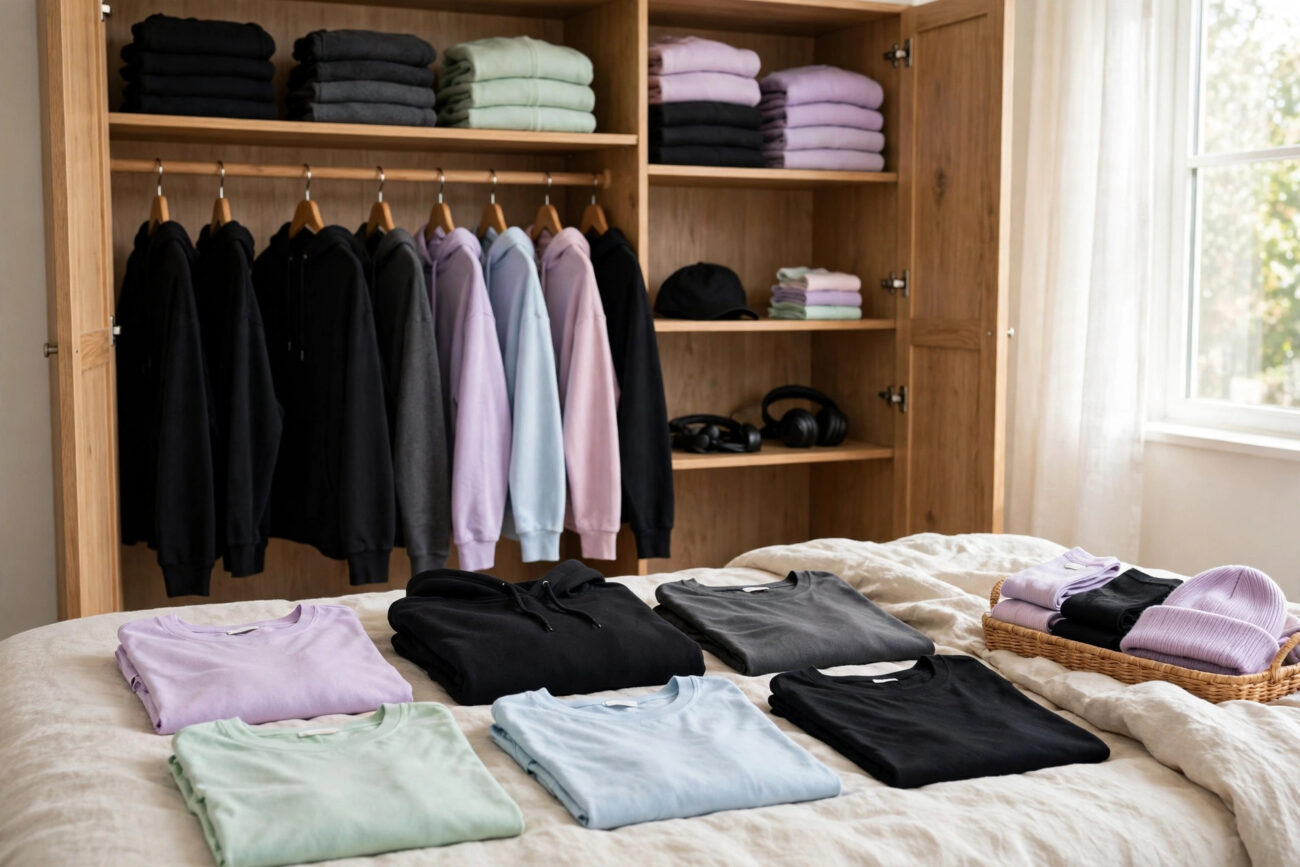
The problem with building a gamer girl wardrobe is that it usually starts with a shopping cart. A stream looks flat, a convention is coming up, a new game drops and suddenly the answer feels like a haul — new tops, new skirts, new accessories, a whole new closet. Then the packages arrive, half of it only works with other new things that were not in the cart, and the closet ends up fuller and harder to dress from than before. The pieces were never the real problem. The real problem is that most closets have never been audited: nobody has counted what is actually in there, sorted what earns its space from what is just stored, or worked out which combinations the existing pieces already make. A wardrobe is not a pile of clothes. It is a system — a set of pieces that fit your actual week, mix with each other, survive your laundry habits, and cover the situations you really dress for, which for a gamer girl usually means stream days, casual days, and the occasional event where the fandom gets to show. This guide builds that system out of the closet you already own, in the order that works: audit first, remix second, and only then — with a written gap list in hand — buy the very few pieces that are genuinely missing.
Start here: Browse the gamer girl apparel collection with your gap list beside you, not before you have one — the list is what turns browsing into finishing a wardrobe instead of restarting one.
Key Takeaways
- A wardrobe is a system, not a pile: the audit comes first, and most closets already contain the core of a working gamer wardrobe.
- Sort by evidence — what you actually wore in the last season — not by what you meant to wear or what it cost.
- Remix math beats volume: a small set of pieces that all pair together makes more outfits than a large set of pieces that only pair with themselves.
- Color discipline is what makes remixing possible; one base palette plus your fandom accents turns separate pieces into a wardrobe.
- The gap list is the only shopping list: buy the few pieces that unlock the most combinations, one at a time, and check fiber and care labels before price tags.
- What leaves the closet should leave responsibly — resale, donation, and textile recycling all beat the trash, and the data on clothing waste says the trash is where most of it currently goes.
Table of Contents
- The Audit: Count What You Actually Own
- Sort by Evidence, Not Intentions
- The Remix Math: Why Fewer Pieces Make More Outfits
- Color: The Palette That Makes It a Wardrobe
- Fit the Wardrobe to Your Actual Week
- The Gap List: The Only Shopping You Do
- Labels Before Price Tags
- What Leaves, and Where It Should Go
- Our View
- FAQ
- Sources
- Recommended
The Audit: Count What You Actually Own
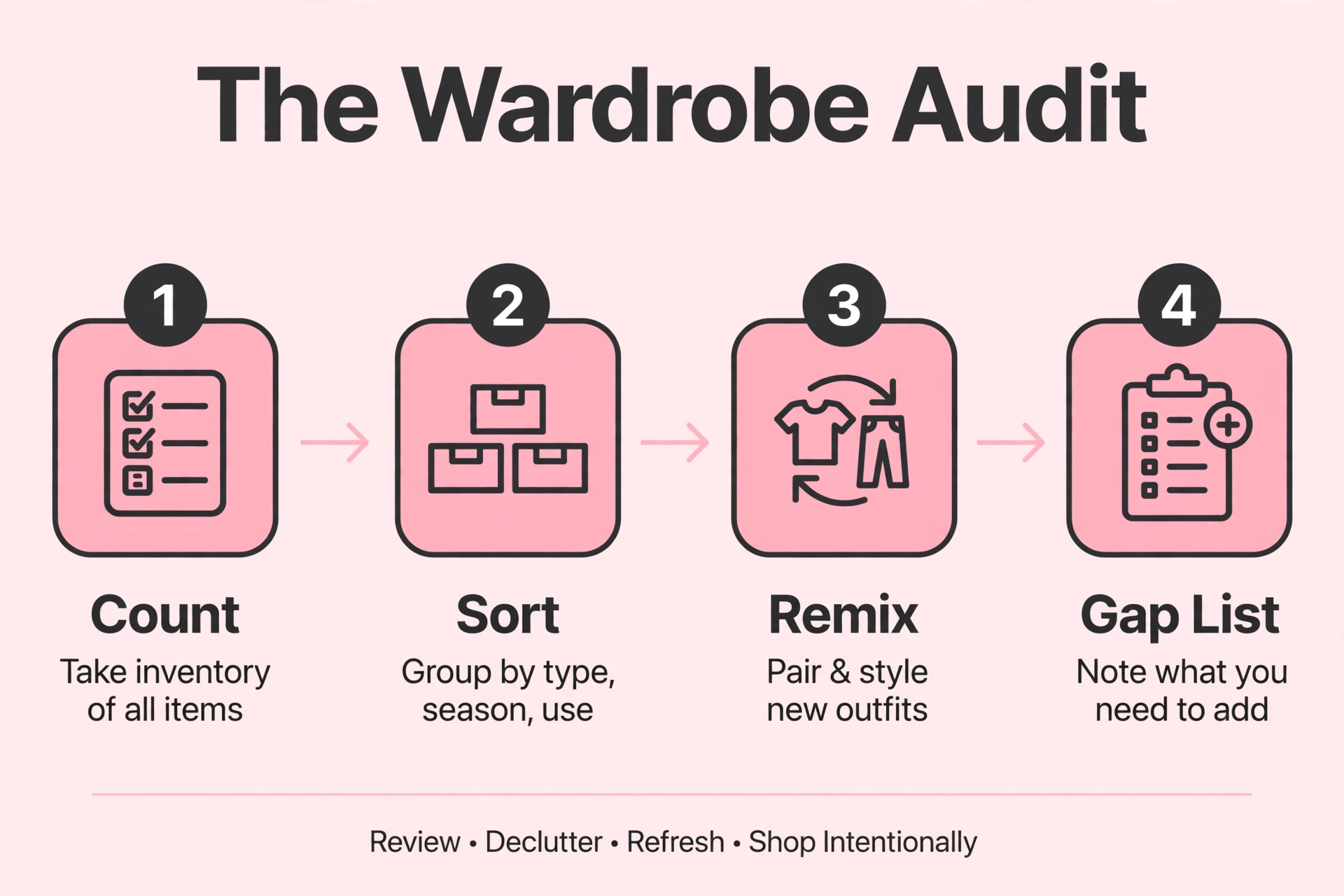
Every wardrobe rebuild that works starts with an inventory, because you cannot fix a system you have never seen whole. Take everything out — closet, drawers, the chair that has become a second closet — and lay it out by category: tops, bottoms, dresses, layers, shoes, and the fandom pieces that do not fit neat categories. Then count. The count itself is the first piece of information most people have never had about their own wardrobe, and it is usually a surprise in both directions: more black tees than anyone needs, and somehow only one bottom that works with all of them. Write the inventory down, on paper or in a notes app, because the audit’s output is a document you will use for every later step — the sort, the remix test, and the gap list all read from it.
The audit is also where the capsule idea earns its keep, used as a lens rather than a rule. The college capsule approach described by College Compass limits a working wardrobe to a defined set of loved, needed pieces for a season and starts, exactly as this guide does, with taking inventory of the closet and putting away what does not earn its place. You do not need their number or anyone’s number. What you need from the capsule idea is the question it asks of every piece: does this earn its space by being worn, in combinations, in your real life? A piece can fail that test by fit, by condition, by needing a partner you do not own, or by belonging to a life you do not actually live — the five formal dresses of someone whose events are game launches and conventions. The audit does not judge the answers yet. It just makes them visible, category by category, so the sort that follows is working from facts instead of from the feeling that there is nothing to wear.
| Category | Count what you own | Note beside it |
|---|---|---|
| Tops | Every tee, blouse, tank, and sweater | Which ones you reached for this month |
| Bottoms | Jeans, skirts, shorts, leggings | Which tops each one actually pairs with |
| Layers | Hoodies, cardigans, jackets | Whether they fit over your real tops |
| Fandom pieces | Graphic tees, cosplay-lite items, merch | What they need to become outfits |
| Shoes | Every pair in rotation | Which outfits they finish |
Sort by Evidence, Not Intentions
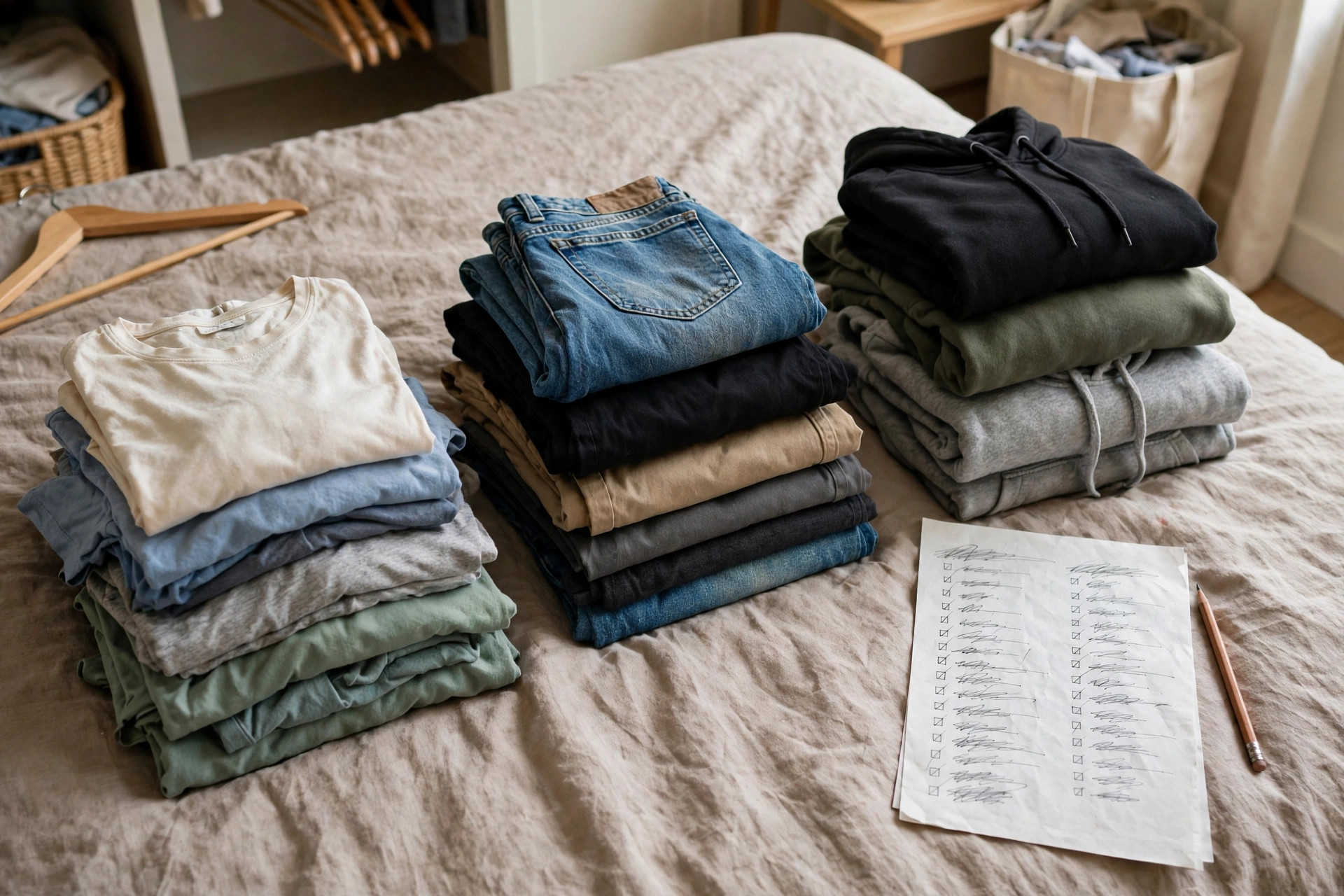
The sort works when it is run on evidence — what you wore — and fails when it is run on intentions, guilt, and original price tags. Make four piles. Keep: pieces you wore in the last season and would wear again this week. Repair: pieces you would wear if one fix happened — a button, a hem, a strap — with the fix written on the inventory so it becomes a task instead of a wish. Store: genuine out-of-season or occasion pieces, boxed and labeled, out of the daily closet. Leave: everything else, and be honest about what everything else is — the size you are not, the style you tried once, the gift you never liked, the piece that only works with a partner that left two years ago. The evidence rule settles most arguments with yourself: if a piece has not been worn in a full cycle of its own season, it is not part of your wardrobe, whatever it cost. Cost is gone either way. Space, attention, and getting-dressed time are what the unworn piece is still charging you.
Two traps catch almost everyone at this stage. The first is the almost-piece: the top that would be perfect if it were one size different, one color different, one inch longer. Almost-pieces are gap-list writers in disguise — the specific way they fail tells you exactly what the right version looks like, which is information worth writing down before the piece leaves. The second trap is keeping duplicates of a failure: four versions of the same uncomfortable shoe do not add up to one comfortable one. Duplicates of a success are different — if you wear the same black tee four days a week, owning it in multiples is the wardrobe working as designed. The distinction the sort is really making is not between good clothes and bad clothes. It is between clothes that participate in your actual rotation and clothes that are only stored in your home, and a wardrobe is only the first kind.
The Remix Math: Why Fewer Pieces Make More Outfits
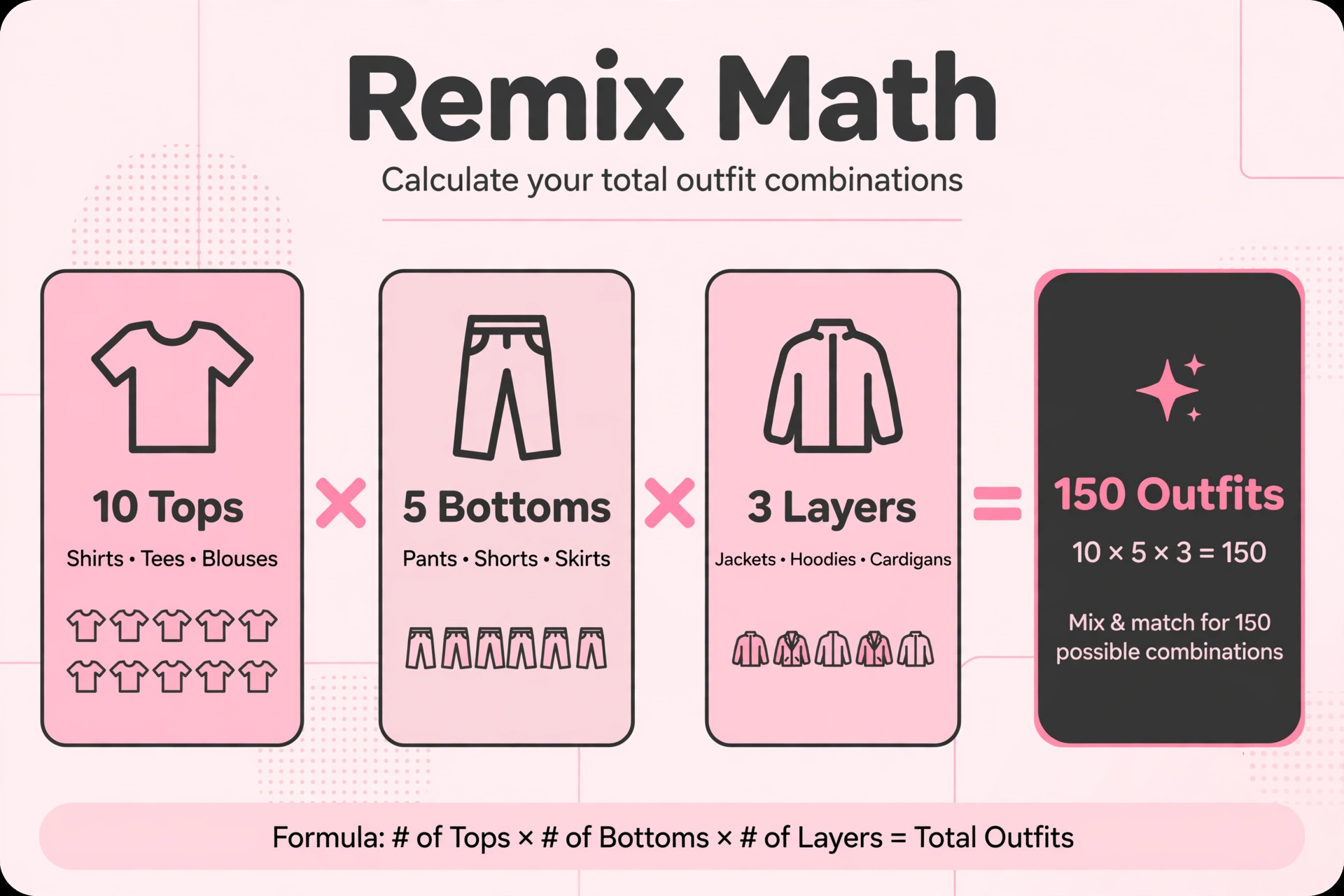
Outfits multiply; they do not add — and that single fact is why a smaller, coordinated closet out-dresses a bigger random one. Ten tops and five bottoms that all pair together are fifty base outfits before layers and shoes enter the count. Thirty tops and ten bottoms that only pair in a few fixed couples are barely more outfits than the couples themselves, because a piece that goes with one thing contributes exactly one outfit no matter how long it hangs there. This is the arithmetic underneath the capsule idea, and it changes what a good piece is: a piece is good in proportion to the number of partners it has. When you lay your keep pile out after the sort, do the pairing test physically — tops across the bed, bottoms below them — and count the combinations you would genuinely wear. The pieces with no partners are not necessarily leaving; some of them are one gap-list purchase away from unlocking a whole row of outfits. But now you know which ones they are, and you know it from your own closet’s math rather than from a shopping site’s suggestions.
The remix test also exposes the wardrobe’s hidden structure: most people discover their closet is really two or three mini-wardrobes that do not talk to each other — a stream wardrobe, a going-out wardrobe, a comfort wardrobe — each missing the bridges that would let pieces cross over. Bridges are unglamorous and cheap relative to their effect: the plain layer that makes a graphic tee work in three settings, the bottom that pairs with both the merch tops and the plain ones, the shoes that finish both the casual and the dressed-up ends of the closet. When the gap list is written later, bridges come first, because a bridge does not add one outfit — it multiplies two piles you already own. This is also where a gamer wardrobe has an advantage worth using: fandom pieces are natural accents. A graphic tee, a character hoodie, a subtle accessory from a favorite series can be the rotating accent over a stable base of remixable basics, which means the personality of the wardrobe can change daily while the system underneath stays small, known, and already paid for.
Color: The Palette That Makes It a Wardrobe
Remixing only works when the colors cooperate, and color cooperation is a decision you make once, on paper, instead of rediscovering badly in front of the mirror every morning. Look at your keep pile and name what is actually there: most closets already have a palette trying to happen — a run of black and charcoal, a streak of pastels, a denim spine — buried under one-off pieces in colors that match nothing else you own. The working method is simple: choose your base from what you already own most of, choose one or two accent families from the pieces you love most, and let the inventory show you which pieces fall outside the palette entirely. Outside pieces are not automatically out — a beloved statement piece can be a deliberate exception — but they should be exceptions on purpose, few enough that you can name them, rather than a third of the closet by accident.
Color has a second job in a gamer wardrobe, which is behaving on camera. The photography guidance at Cambridge in Colour explains white balance as the process that keeps colors rendering true on camera, and its practical lesson for a wardrobe is that colors are judged by your viewers under your light, not under the store’s. A palette built from your own most-worn colors has already passed the only test that matters — you have seen yourself in them, in your room, on your camera. When a gap-list purchase does happen, this is the check to run before the piece is final: hold it against the palette, then look at it in your stream lighting and your daylight, because a color that only works in one of those is a part-time piece and should be priced in your head accordingly. Palette discipline sounds like a restriction and behaves like the opposite: it is what lets a new piece arrive already knowing its partners, instead of starting the nothing-to-wear problem over again with tags on.
Fit the Wardrobe to Your Actual Week
A wardrobe should be built for the week you live, in the proportions you live it — and most closets fail here silently, stocked for an imaginary schedule. Write down your real week: how many stream days, work or school days, errand days, social days, and full-home days it actually contains, and what each one asks you to wear. Then hold the keep pile up against it. The mismatches are usually obvious once they are side by side: a closet heavy on event pieces for someone who streams four nights a week, or heavy on loungewear for someone whose camera is on daily and whose upper half is, professionally, the whole outfit. For stream days specifically, the platform rules are part of the week’s real requirements — YouTube’s community guidelines on nudity and sexual content and the Twitch attire expectations summarized in Sirency’s Twitch attire policy guide both shape what a stream wardrobe has to include: pieces that read clearly as outfits on camera, in frame, for hours. A wardrobe fitted to the real week keeps those rules in the keep pile by default, instead of discovering them mid-stream.
Proportions are the fix, and they are forgiving: the goal is not a perfect ratio but a closet where the biggest pile matches the biggest part of your week. If most of your days are home-and-stream days, the wardrobe’s center of gravity should be comfortable, camera-ready tops, the bottoms that work with them, and the layers that make both feel finished — with event and formal pieces stored as the minority they are. This is also the step where the gamer-specific pieces get their honest placement. Merch and fandom items usually deserve more rotation than a generic wardrobe method would give them, because for this wardrobe they are not novelties; they are the point. The method does not change, only the inputs: your week, your camera, your fandom. A wardrobe that fits those three is already most of the way built, and it was built by rearrangement.
The Gap List: The Only Shopping You Do
After the audit, the sort, the remix test, and the week-fit check, the wardrobe will tell you what it is missing — and that list, written down, is the only shopping this process allows. A true gap has a specific shape: it is a piece whose absence blocks outfits that otherwise exist. The layer that would let five tops work in cooler weather. The bottom that pairs with the whole top row. The shoes that finish the dressed-up end of the closet. Write each gap as a specification, not a product — color from your palette, category, what it must pair with, what it must survive — because a specification can be filled by a sale, a thrift find, a swap, or a deliberate full-price purchase, while a product name can only be filled by buying that product. The site’s own gamer girl apparel collection is the natural first place to check a written specification against, precisely because you now know what you are looking for.
Then buy slowly, in list order, one piece at a time, and re-run the pairing test as each piece lands. One-at-a-time is not frugality theater; it is how you find out whether the gap was real. Sometimes the first bridge piece unlocks so much that the second gap shrinks or vanishes — the layer makes the stored pieces wearable, the bottom revives three tops you had half-written-off. A gap list also has a stopping rule, which a shopping cart never does: when every remaining piece in the closet has partners and every day of your real week is covered, the wardrobe is done, and further buying is not building, it is just buying. Expect the finished list to be short. In most audits it is two to five pieces — a fact that feels anticlimactic only until you compare it with the cost of the new closet it replaced.
Labels Before Price Tags
When a gap purchase does happen, the label is a better predictor of whether the piece earns its place than the price, the photos, or the reviews. The Federal Trade Commission’s guide to labeling requirements under the Textile and Wool Acts explains what fiber-content labels must tell you, and the FTC’s guide to complying with the Care Labeling Rule covers the care instructions every garment has to carry. Read together, those two labels answer the wardrobe questions that matter: what is this actually made of, and what will keeping it cost me in effort? A piece whose care label demands a routine you will not do is a piece that will quietly leave your rotation within a month, whatever it cost. A fiber blend you already own and like, in a new piece, is a known quantity — your closet’s own history is data about what you will actually wear and wash.
Care is where the wardrobe system either holds or leaks, because a remix wardrobe wears its pieces often, which means it washes them often. The American Cleaning Institute’s laundry basics cover the fundamentals that decide garment lifespan — sorting, water temperature, and reading the care label before the wash rather than after the shrink. In a big random closet, a ruined piece is a shrug; in a small coordinated one, every piece is load-bearing, so the boring skills — washing like colors together, closing zippers, turning printed and graphic pieces inside out — are structural. This is especially true for the fandom pieces, whose prints are usually the first thing a harsh wash cycle takes. The wardrobe you built from your own closet will last exactly as long as its care routine, which is one more reason the system beats the haul: you cannot re-buy your way out of a care problem, but you can wash your way out of most of one.
What Leaves, and Where It Should Go
The leave pile is not trash, and treating it as trash is the one genuinely wasteful option the audit offers. The scale of the alternative is in the U.S. Environmental Protection Agency’s textiles data: discarded clothing is the main source of textiles in municipal solid waste, and the agency’s figures put textile recycling well behind generation — most discarded textiles are landfilled. Against that background, the leave pile has a clear order of exits. Sell what has resale value, locally or on resale platforms, and price it to move rather than to recover what you paid. Swap what a friend would genuinely wear. Donate what is clean and wearable: Goodwill’s own account of what happens to donated clothes describes sorting, a run on the sales floor, then outlets and textile-recycling partners for what does not sell — a chain with several chances in it, which is exactly what a wearable piece deserves. Goodwill of South Central Wisconsin’s sustainability overview describes the same donation lifecycle from the other side: retail, e-commerce, outlet, then recycling and reuse partners before disposal is considered.
What remains after those exits — the worn-out, the damaged, the single shoes of the clothing world — goes to textile recycling where your area offers it, in a bag marked as salvage if your donation point asks for that, rather than mixed into a donation bag where it slows the sorting for everything else. None of this needs to happen in a weekend. The leave pile can leave in stages, a bag at a time, as each exit gets arranged. What matters is the direction: the audit turned stored clothes back into a wardrobe for you, and the exits turn the surplus back into clothes, materials, or funding for someone else. A smaller closet and a fuller landfill is the one outcome this whole process exists to avoid.
Our View
Your new wardrobe is already in your house. Audit it, sort it by what you actually wear, run the remix math, fit it to your real week, and let the gap list — not a sale, not a mood, not a haul video — decide the handful of purchases that finish it. The closet gets smaller, the outfits get more numerous, and the next time you think you have nothing to wear, you will have a document that proves otherwise.
— The GamerChicksRule Team
FAQ
How many pieces should a gamer girl wardrobe have?
There is no correct number, and any method that starts with one is selling you a shopping list. The working test is coverage and partners: every day of your real week is dressed, and every piece you keep pairs with several others. For most people that lands somewhere in capsule territory — a few dozen pieces in active rotation — but your audit’s numbers, not a template, decide it.
What if my audit shows I genuinely own almost nothing wearable?
Then the audit did its most valuable job: it told you the truth cheaply. Build the gap list in priority order — bridges and basics first, accents later — and fill it slowly, one specified piece at a time, checking thrift and resale before retail. A small wardrobe built deliberately from near-zero still beats a fast closet built by hauls, because every piece in it was chosen against the list.
Should fandom and merch pieces count in the wardrobe, or are they extras?
They count, and in this wardrobe they are often the accents the whole system rotates around. The test is the same as for any piece: does it have partners, does it fit your real week, and does it pass your platforms’ attire rules on stream days? A graphic tee that pairs with three bottoms and a layer is a working wardrobe piece by any measure.
How often should I re-audit?
Once a season is enough for most closets, and the second audit is far faster than the first because the inventory document already exists. Re-audit when your week changes — a new streaming schedule, a new job, a move — since the wardrobe is fitted to the week, and a changed week is the one event that can make a good wardrobe wrong.
Is it worth repairing pieces instead of replacing them?
Usually, when the piece already has partners and fits your palette — a repair restores a known, working part of the system for less than a replacement costs, and the replacement would still have to prove itself in the pairing test. Repair stops making sense when the piece fails on fit or palette as well as condition; then it is a leave-pile piece with extra steps.
Sources
- FTC guide to labeling requirements under the Textile and Wool Acts
- FTC guide to complying with the Care Labeling Rule
- American Cleaning Institute laundry basics
- U.S. EPA textiles material-specific data
- Goodwill on what happens to donated clothes
- Goodwill of South Central Wisconsin sustainability and the donation lifecycle
- College Compass college capsule wardrobe
- YouTube community guidelines on nudity and sexual content
- Sirency Twitch attire policy guide
- Cambridge in Colour on white balance